
FluxOps
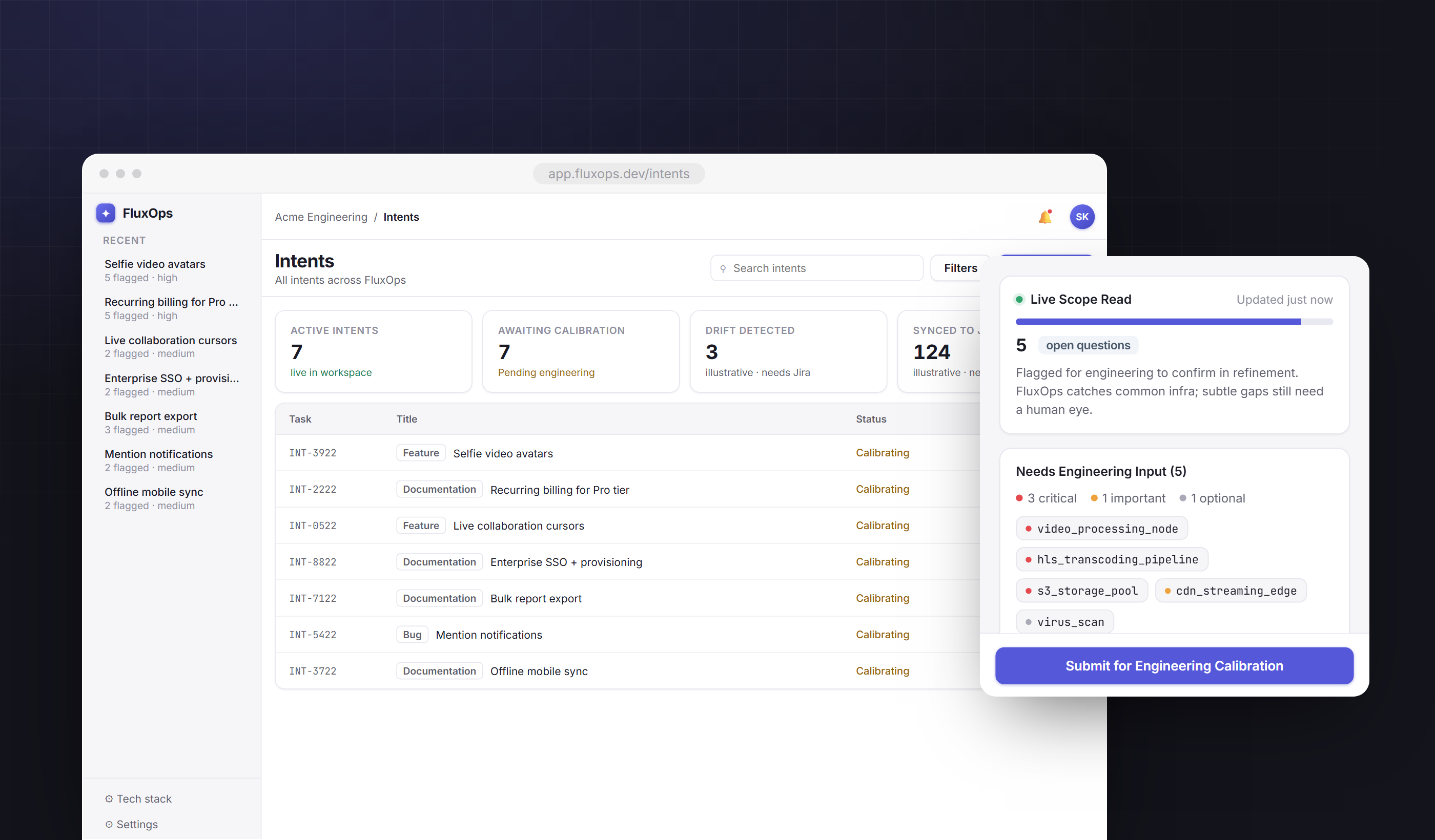
A structured-intent drafter for product teams. As a PM writes an intent, FluxOps turns it into a clean, decomposed, Jira-ready ticket and raises the open questions it leaves for refinement, so engineering walks in with better-shaped questions instead of a paragraph.
- Role
- Designer & Solo Operator
- Type
- Personal Concept
- Status
- In Design
- Form Factor
- Web App + Clipboard Loop
What it actually changes
The handoff surprise does not show up in any single sprint. It compounds across quarters as wasted dev cycles and work re-scoped mid-sprint. FluxOps does not promise to price that away. What it changes is smaller and honest:
These describe the shape of the value, not measured outcomes. FluxOps is a concept in design. Real numbers replace these only once it runs with a real team.
Draft the ticket, surface the questions, resolve them before the sprint
Most product operations tools (Jira, Linear, Notion, Confluence) are passive archives. They store what humans manually log, and the burden of keeping the system in sync falls entirely on the humans. The tooling is dumb; the people compensate.
FluxOps reads the intent the moment a PM writes it, decomposes it into a clean Jira-ready ticket, and raises the open questions it leaves while answers are still cheap. It does not claim to know what your stack is missing; it asks. The MVP proves the whole thesis on one workflow: a PM drafts an intent, the engine drafts the ticket and the questions, and the two sides settle each open item before it reaches the sprint.
Static tooling, communication debt
The cost above isn't a velocity problem, it's a handoff problem. The PM's intent and engineering's reality live in separate tools and only meet when the ticket opens, usually mid-sprint, when changing course is expensive.
- PMs write the intent with no visibility into the technical constraints.
- Engineers discover the missing infrastructure when they open the ticket, mid-sprint.
- Nobody owns the conversation in between, so it happens late, verbally, and undocumented.
The intent breaks at the handoff boundary. Three specific failure modes compound the friction:
- The Isolated Spec TrapPMs author complex requirements with zero visibility into active technical constraints. Unfeasible specs get discovered mid-sprint, when the engineer opens the ticket and finds a missing infrastructure dependency.
- The Manual Sync BurdenTeams burn hours in status meetings and standups manually linking related tickets, mapping upstream blockers, and tracking progress. The coordination work is the actual product the team ships; the features are downstream.
- The Predictability Black BoxLeadership plots multi-month roadmaps with spreadsheets and historical guesswork. Zero mathematical insight into how technical debt and unbuilt infrastructure drag shipping velocity. Predictions are vibes, not models.
AI drafts the ticket and the questions, both sides resolve them
FluxOps reads the PM's intent and raises questions about what it might lean on: infrastructure that may not exist yet, blast radius worth checking, conflicts with other tickets. Each question becomes a thread the PM and engineering resolve together, Build it, Defer it, or Scrap it, until nothing open remains.
- PM · Writes the intentJira · Linear
- FluxOps · Drafts ticket, opens questionsthe engine
- Engineer · Resolves each threadin-repo context
FluxOps vs. the passive archive
- Data Nature. Status Quo (Jira / Linear): Passive archive, requires constant human logging, ticket linking, status tracking. FluxOps: Live drafting layer. Reads the intent, drafts the ticket, and raises the open questions it leaves to confirm.
- Feasibility Analysis. Status Quo: Post-facto. Engineering limitations discovered late, mid-sprint, when it's expensive to revert. FluxOps: Questions surfaced as you write. Raises what to confirm, possibly-missing primitives and blast radius, before the ticket is committed, for engineering to answer.
- Resolution. Status Quo: Tickets land unresolved; the disagreement surfaces mid-sprint when it is expensive. FluxOps: Negotiated to closure. Each dependency is Built, Deferred, or Scrapped by both sides before the sprint, with the decision logged.
Two roles, one thread, decided before the sprint
FluxOps sits on top of the tracker the team already uses. It reads the intent, surfaces the risk to both sides, and writes the resolved plan back. No migration, no new home for the work.
- PM · The author - Writes the intent, decides at planning altitudeDrafts in the tracker. Sees the open questions, not implementation detail. When engineering proposes a resolution, the PM approves it or pushes back on scope. Friction removed: discovering "wait, is this even possible" three days into the sprint.
- The thread · The artifact - One source of truth, two doors inEvery flagged dependency is a thread both sides act on. The back-and-forth (who asked for what, and why it was Built, Deferred, or Scrapped) becomes a decision log that outlives the sprint. Friction removed: "why did we build it this way" with no record.
- Engineer · The reality check - Reviews the blast radius, proposes the callSees exactly where the intent touches the codebase, in context. Proposes Build, Defer, or Scrap per dependency. Friction removed: being the bearer of bad news three weeks into a sprint.
The intent-to-resolution workflow
The MVP scope is cut to a single high-leverage workflow: as the PM writes an intent, FluxOps drafts the ticket, surfaces the open questions, and opens a thread on each. The PM and engineering resolve every thread, Build, Defer, or Scrap, and only then does it seal for the sprint. Everything else is V2.
- Live question read, the open questions update as the PM writes, before the intent is even saved
- Question surfacing, every primitive the intent may need that was not found in the stack, raised as a question to confirm
- Per-dependency resolution, each flagged item is a thread settled Build, Defer, or Scrap by both sides
- Sprint-ready handoff, the co-authored plan pushes to Jira or Linear once every dependency is closed
How the question read works
As the PM writes, an LLM decomposes the intent into the capabilities it needs, then checks each against what already exists. The output is a set of questions, not a verdict: high-recall and medium-precision, raised for the engineer to confirm. It works spec-only on day one and sharpens as you connect more context, a service catalog first, then the repo itself.
- No open questions. The intent maps cleanly to what the stack already has.
- A few to confirm. Mostly there, a couple of primitives worth a quick check.
- Several to resolve. The intent leans on things not found in the stack, worth a conversation before the sprint.
The MVP never touches the codebase. It grounds against the service catalog the team pasted in, so there is nothing to parse and no token bomb to defuse. When you do connect the repo later, it still never reads raw logic: it maps the code to a skeletal index of signatures (routes, exports, function names), a few KB instead of 50MB of implementation, so the read stays local, instant, and on-target.
Day one, the read will sometimes be wrong, that is what medium precision means. The fix is not more precision, it is cheap correction. A flag reads like a junior dev raising a hand ("did we already build a transcoding pipeline?"), and dismissing it in one keystroke writes that primitive back into the catalog. Every correction grounds the engine, so it gets measurably less wrong each time an engineer touches it. Trust is the derivative, not the starting point.
The decision node
Each intent normalizes into a decision node: a structured object carrying the intent text, the open questions, the dependency tree with each thread's status, and the resolution. Same shape regardless of complexity.
{
  "intentId": "INT-402",
  "text": "Users can record a 60-second selfie video and set it as their profile avatar.",
  "openQuestions": 3,
  "dependencies": [
    { "id": "hls_transcoding_pipeline", "severity": "critical", "status": "needs-pm", "resolution": null },
    { "id": "s3_storage_pool", "severity": "critical", "status": "with-eng", "resolution": null },
    { "id": "video_processing_node", "severity": "critical", "status": "resolved", "resolution": "build" }
  ],
  "grounding": "repo-indexed",
  "sealed": false
}How to actually ship this without an enterprise backend
A platform that promises cross-functional alignment typically requires complex multiplayer infrastructure, security review cycles, and corporate data integrations. None of that is realistic for a solo operator. Three architectural decisions cut that complexity to zero:
- The Local Data SandboxThe MVP runs as a single-page web app on browser localStorage. No user databases, no auth flow, no data-residency contracts, no security review. It runs in someone's browser, on their data, on their machine. "No infrastructure. No backend. Ships in weeks, not quarters."
- The Zero-Integration LoopInstead of waiting for corporate security approvals to read private GitHub or Jira data, FluxOps runs via direct clipboard actions. Paste text specs in. Copy Jira-ready tickets out. No OAuth, no scopes, no SOC2 questionnaire. "The clipboard is the integration layer."
- The Built-In Expansion HookEvery parsed requirement generates a shareable web link. The PM hits Share Context Link, the engineer opens the web view, sees the technical tasks already mapped, and gets the value instantly, with no onboarding, signup, or install. "Viral coefficient by design."
These three decisions are not concessions, they're the product. A FluxOps that required enterprise infrastructure on day one would be a FluxOps that never ships.
The decisions that shaped the surface area
- Questions over verdicts. The tempting version asserts what your stack is missing. FluxOps refuses, because the incumbent for that judgment is a senior engineer reading the ticket, and a medium-precision model checking a hand-pasted list is not more accurate than that read. So FluxOps does not replace the engineer's read, it preps it: a forcing function that makes the PM articulate the intent in decomposable terms, a clean ticket as the output, and a shared, question-framed artifact the refinement runs on. Being wrong about a question costs nothing; a confident false claim costs trust.
- localStorage over real backend. Persistent data, multi-user collaboration, and cross-session sync are all V2. The MVP cannot afford them. The cost of that decision is acknowledged: every user starts from scratch on every device, and sharing requires the explicit context-link export. That friction is the price of shipping in weeks instead of months.
- Clipboard over webhook. A real webhook integration with Jira / Linear / GitHub would feel more native. It would also require OAuth, scope reviews, and per-customer integration setup. The clipboard loop gives 80% of the value with 5% of the engineering. V2 introduces real webhooks once the workflow has been validated.
- Human-approves-every-injection. A faster product would auto-inject the generated engineering plan into the team's sprint backlog. FluxOps enforces an explicit human approval on every plan. Trust on this category of tool is hard-won and easily lost; the friction is deliberate.
- Permanent No on auto-approving PRDs. The strong temptation is to ship "the LLM will write the spec and approve it for you" features. FluxOps kills that path explicitly. Auto-execution collapses the trust model the first time a confidently-wrong AI plan reaches production. It's on the roadmap as Never, not Later.
- Two roles, not a universal graph. The tempting version connects every tool: PM, design, engineering, infra. That dilutes the wedge and overlaps tools that already own those domains. FluxOps stays on the PM-to-engineering seam, where the expensive, late disagreements actually happen. Design-system readiness is a real concern; it just isn't this tool's job.
- Ephemeral chamber over a sync engine. Keeping FluxOps live against Jira in real time would mean background polling, webhook handlers, and exponential backoff against tiered API rate limits, the exact integration surface the clipboard loop exists to avoid. So FluxOps is a negotiation chamber, not a system of record. Once the threads close and the plan lands in the tracker, the session is done. If reality moves later, you paste the new spec into a fresh session and FluxOps delta-checks it, the manual version of the live re-open graph, with none of the sync infrastructure.